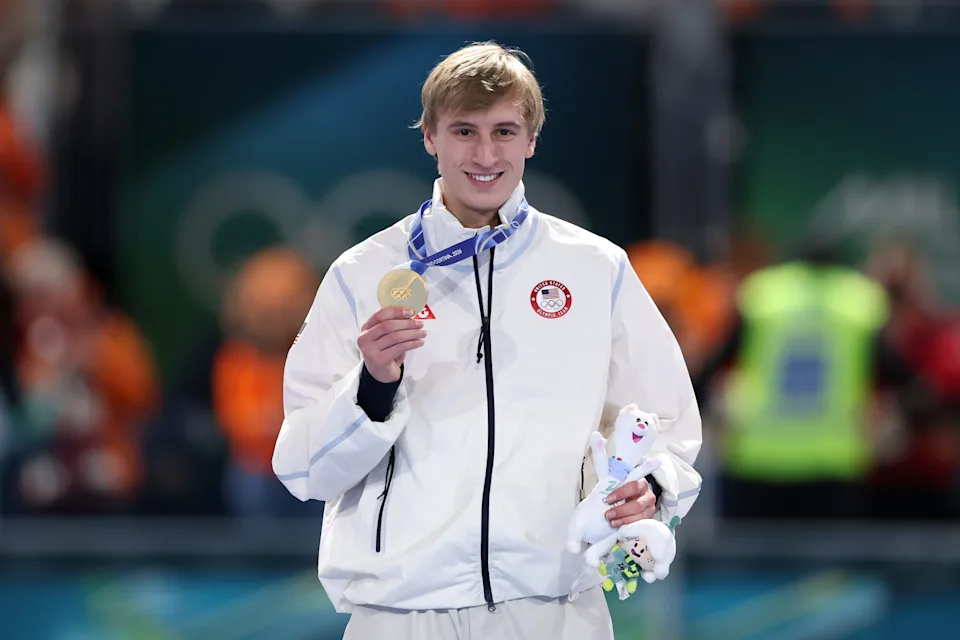
The men's speed skating program at the Milano Cortina 2026 Winter Games has featured sustained high-level performance across multiple distances by a single competitor, prompting evaluation of historical benchmarks in the sport. The athlete in question has secured gold medals in the 500m and 1000m events, with competition remaining in the 1500m and mass start disciplines.
Competitive Schedule and Historical Context
The 1500m event, scheduled for February 19, represents the third distance in a potential four-gold sequence. Historical precedent for such achievement is limited: only two athletes have won four gold medals at a single Winter Olympics, with the most recent instance dating to 1980. The mass start event on February 21 offers the final opportunity for this outcome.
The athlete's seasonal performance data indicates dominance in the 1500m distance, with undefeated World Cup records across five 2025-26 season appearances and consecutive World Single Distances Championship titles in 2023 and 2024. A silver medal at the 2025 Championships represents the only deviation from this pattern over a three-year competitive window.
Technical Discipline Variation
Speed skating's multi-distance structure requires physiological adaptation across contrasting energy system demands. The 500m and 1000m events emphasize anaerobic capacity and acceleration mechanics, while the 1500m incorporates significant aerobic contribution. The mass start introduces tactical variables including drafting, positioning, and sprint timing absent from individual time trial formats.
The athlete's proficiency across these divergent specifications suggests exceptional versatility or training methodology optimization. Historical comparison to the 1980 five-gold performance is complicated by program changes: the mass start was not contested in that era, and the 1000m has undergone format modifications.
Performance Metrics and Record Progression
Olympic records have been established in both completed events, with times significantly below previous benchmarks. The magnitude of these improvements—particularly in the 500m, where margins are typically fractions of seconds—indicates potential equipment or ice preparation advances rather than purely physiological progression.
The 1500m Olympic record, set at Beijing 2022, stands at 1:43.21. Seasonal World Cup times from the athlete suggest capacity to approach or exceed this benchmark, though ice conditions at the Milano venue and aerodynamic factors introduce uncertainty.
Generational and Developmental Factors
The athlete's age (21) places this performance within an early-career trajectory unusual for sustained multi-event dominance in speed skating. Peak performance in the sport historically occurs between 28-32 years, suggesting either accelerated development timelines or potential for further progression.
The Wisconsin training base represents a non-traditional location for elite speed skating, lacking the ice infrastructure concentration of Dutch or Norwegian development systems. This geographic anomaly may indicate individualized training approaches or technological compensation for environmental limitations.
Governance and Competitive Structure
The mass start event's inclusion in Olympic programming since 2018 has created additional medal opportunities but also altered historical comparison frameworks. The tactical complexity of mass start—where finishing position rather than time determines ranking—introduces variance that individual time trial formats minimize.
International Skating Union regulations regarding aerodynamic suit specifications and skate blade technology have undergone revision since 2022, with potential performance implications not yet fully quantified across competitive populations. The athlete's equipment configuration may provide data points for these regulatory evaluations.
Commercial and Media Considerations
Broadcast scheduling of the 1500m event at 10:30 p.m. ET reflects prioritization of European prime-time audiences over North American markets, despite the athlete's United States origin. This distribution pattern may influence domestic audience engagement metrics and subsequent sponsorship valuation.
Historical performance comparisons generate narrative content for rights holders, though quantitative equivalence across eras remains methodologically contested. Ice surface technology, training load monitoring, and nutritional optimization have evolved substantially since 1980, complicating direct performance indexing.
Future Program Implications
Sustained success across four distances would establish a performance benchmark potentially influencing talent identification priorities. National federations may evaluate specialization versus multi-distance development pathways based on this outcome, with resource allocation implications for junior program structures.
The athlete's trajectory also carries implications for International Olympic Committee sport program evaluations. Speed skating's continued inclusion depends partly on star athlete generation and competitive narrative development, factors this performance sequence demonstrably supports.
Comments