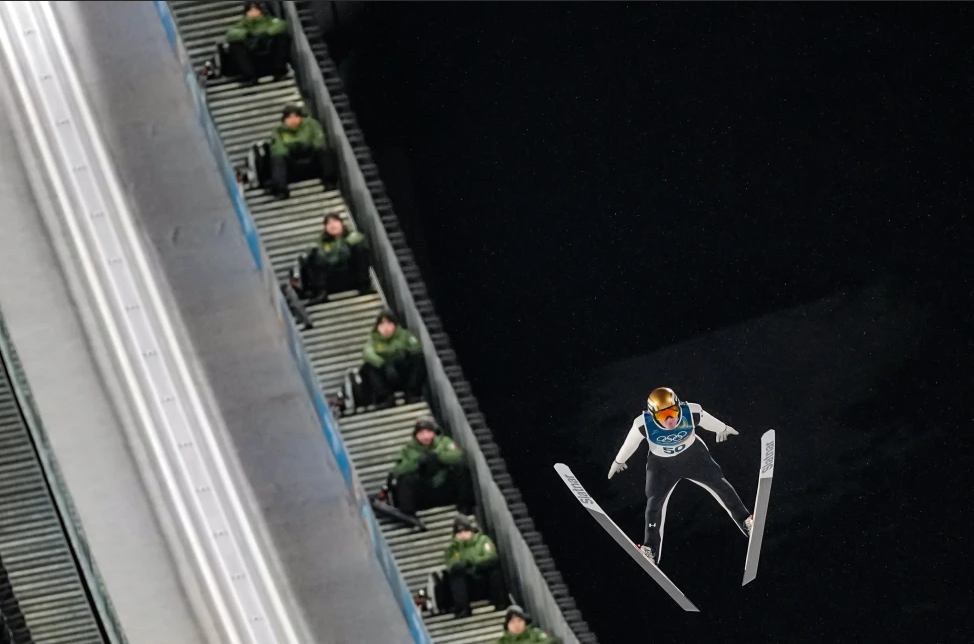
The men's large hill ski jumping competition at the Milano Cortina 2026 Winter Games concluded with a hill record performance of 141.5 meters determining the gold medalist. Competition conditions at the Predazzo venue featured precipitation and low temperatures, introducing additional variables to an already technically demanding discipline.
Competition Outcomes and Structural Patterns
The final round saw the leader entering the last jump ultimately finish second, with the eventual winner overcoming a 7-point deficit through distance and execution. The bronze medalist, in his debut World Cup season, displaced a more established competitor from the podium through second-jump performance. All three medalists were first-time Olympians, indicating competitive turnover in ski jumping's generational transition.
The winning athlete secured a second gold medal of these Games following victory in the mixed team event, where sibling pairing produced a historic result. This marks the fourth sibling from the same family to win Olympic medals in ski jumping, suggesting sustained familial transmission of technical expertise and competitive psychology across generations—a phenomenon observed in multiple technical sports but particularly pronounced in ski jumping given its specialized equipment and regional development concentrations.
Technical Performance Metrics
The hill record of 141.5 meters exceeded previous benchmarks at this venue, though wind conditions and gate settings require normalization when comparing distances across competitions. The 5-meter differential between first and second place in the final round proved decisive given the scoring system's distance-point conversion rates.
The silver medalist's accumulation of three medals across individual and team formats demonstrates versatility between normal and large hill specifications, while the bronze medalist's rapid progression from World Cup rookie to Olympic podium suggests accelerated development pathways in emerging ski jumping nations.
Generational and Familial Dynamics
Ski jumping exhibits notable patterns of familial success, with technical knowledge transmission occurring through shared training environments and equipment access during developmental years. The concentration of medal-winning siblings from specific regions—particularly Slovenia and Norway—indicates ecosystem effects where facility proximity and coaching continuity create compounding advantages.
The winning athlete's status as defending world champion and season-long World Cup leader entering the competition establishes expected performance parameters. The deviation from this pattern—trailing after the first round—highlights the volatility inherent in two-round formats where single-jump execution variance can override seasonal consistency metrics.
Competitive Format Implications
The men's large hill event maintains format parity with women's competition introduced at these Games, though historical participation timelines differ significantly. The mixed team event's success in generating sibling narratives and cross-gender national representation may influence International Ski Federation proposals for additional team formats, potentially including men's and women's team large hill events.
The precipitation conditions during competition tested equipment protocols, particularly regarding ski base preparation and suit aerodynamics. These variables introduce uncertainty that may advantage athletes with greater experience in variable meteorological conditions, typically those from continental climate zones over maritime training environments.
Governance and Development Considerations
Poland's bronze medal represents continued competitive emergence following infrastructure investments in the Zakopane and Wisła jumping complexes. This development trajectory—facility construction followed by competitive results within 5-10 year cycles—provides a model for emerging nations seeking ski jumping program establishment.
Japan's silver medal contributes to a broader Asian competitive presence in ski jumping, historically dominated by European nations. The geographic expansion of competitive depth may influence International Olympic Committee evaluations of sport globalization metrics, relevant to ski jumping's continued program inclusion beyond 2030.
Scoring System Analysis
The 7-point deficit overcome in the final round illustrates the scoring system's sensitivity to distance differentials at large hill specifications. At normal hill parameters, equivalent point deficits require smaller distance differentials to overcome, altering strategic approaches to first-round risk management. Coaches and athletes must calibrate aggression levels based on hill size and competitive position—calculation errors in either direction produce the observed pattern of first-round leaders failing to maintain positions.
The wind compensation system's role in final scores—adjusting raw distances based on measured meteorological data—remains opaque to general audiences and occasionally controversial among competitors. Standardization of wind measurement protocols across venues has improved since 2018, though localized gust patterns continue to introduce unmeasured variance.
Commercial and Broadcast Factors
The nighttime competition scheduling optimized European prime-time broadcast windows, though precipitation reduced visual clarity for television audiences. The hill record distance provided quantifiable narrative content for highlight packages, compensating for reduced aesthetic quality of jumps in suboptimal conditions.
Sponsorship activation for ski jumping equipment manufacturers focuses on binding and ski technologies visible during the 15-second flight phase, with particular emphasis on landing stability given the high-speed impact forces at large hill specifications. The winning athlete's equipment configuration—ski length, binding mounting position, and suit design—will be analyzed by competitor federations for potential adoption.
Comments